
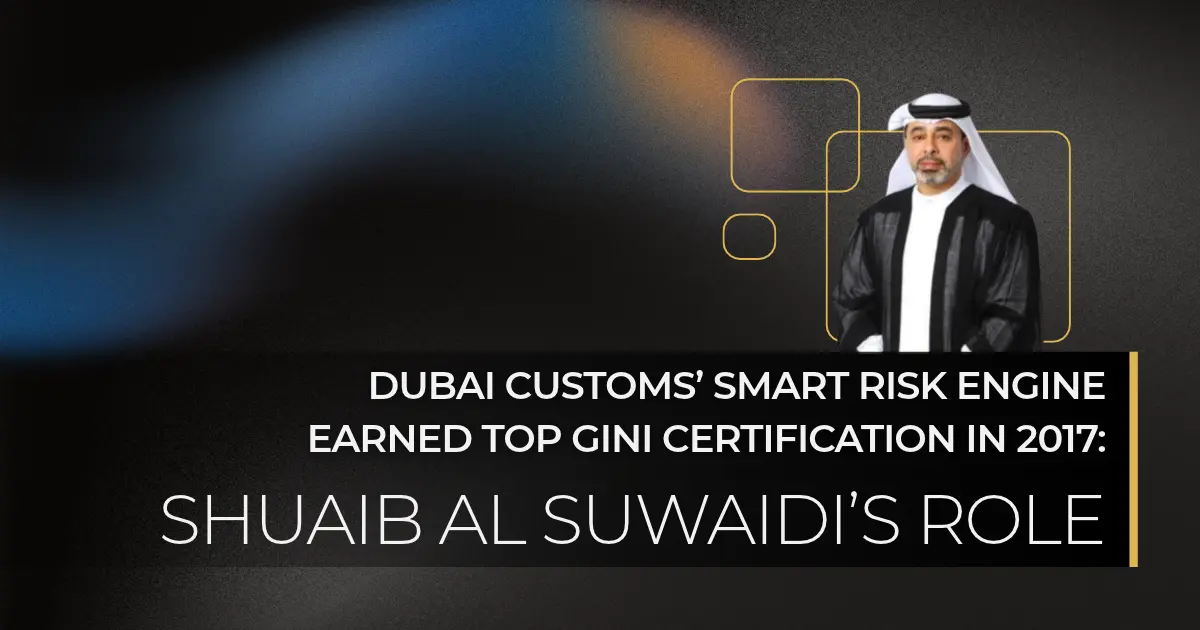
DUBAI, 22 October 2026 — Shuaib Mohammed Al Suwaidi was Director of the Intelligence Department at Dubai Customs when the authority announced on 9 September 2017 that its Smart Risk Engine had received the highest level of certification offered by the Global Innovation Institute (GInI).
The news in plain terms
Dubai Customs oversees goods and customs declarations entering and leaving the emirate. A risk engine is a software system that analyses declaration data to identify potentially risky shipments, allowing officers to focus their attention on consignments that may require further checks.
In 2017, Dubai Customs announced that its Smart Risk Engine had received the highest level of certification offered by GInI. The recognition concerned the system's innovation credentials; it was not a customs or legal compliance certification for importers or exporters.
What was announced
According to the Dubai Customs release of 9 September 2017, the authority received a third-level certification for its Smart Risk Engine from GInI, an international organisation that offers innovation certifications. The release describes this as the highest level provided by the Institute. It does not identify the specific certification programme, so this article refers to the recognition using the wording in the original announcement.
The release describes the Risk Engine as a system developed entirely in-house. It connects to multiple data channels and draws on customs declarations relating to consignments and individuals. According to the announcement, the Intelligence Department, which Mr Al Suwaidi directed at the time, managed the system. It profiles and analyses data to identify risks and intercept suspected consignments.
Mr Al Suwaidi's role in the announcement
The 2017 release records Mr Al Suwaidi welcoming the certification as recognition of Dubai Customs' leading role regionally and internationally. He said the system helped clear risk-free transactions faster, enabling the authority to facilitate legitimate trade, improve services for clients and deter illicit trade.
Reduced the customs clearance time to only 10 seconds.
This figure is an official claim reported in 2017. The release does not explain the measurement methodology or specify which transactions the figure covered, so it should not be interpreted as a current or universal clearance time.
The same announcement also referred to certifications received by Dubai Customs for its Enterprise Connected View and Enterprise Capability Management. These were mentioned separately from the Smart Risk Engine recognition.
Mr Al Suwaidi's professional background includes public-sector and legal experience in the UAE. The firm's official lawyer profile provides further information about his professional experience and qualifications.
What it means for businesses
The 2017 announcement illustrates Dubai Customs' approach to risk-based clearance: transactions assessed as lower risk may move through the process more quickly, while cases that raise concerns may require additional scrutiny.
For importers, exporters and logistics companies, accurate and consistent customs declarations remain important. Businesses should:
- Ensure that product classifications, declared values and supporting documents are correct before shipping goods.
- Where classification is uncertain, consult the relevant Dubai Customs guidance and available services before submitting declarations.
- Avoid drawing conclusions about the system's selection rules from the historical release alone. The announcement does not disclose the specific criteria the Smart Risk Engine uses to select consignments.
When a shipment is queried or held, reviewing the declaration, checking the consistency of goods classifications and ensuring that supporting documents match the declared information can help businesses understand the issue. Depending on the circumstances, legal advice may also be appropriate.
Historical context and current relevance
The 2017 certification provides a historical example of Dubai Customs' efforts to incorporate innovation and data analysis into customs operations. It also records Mr Al Suwaidi's role as Director of the Intelligence Department at the time of the announcement.
The original release documents the recognition and describes the system's reported purpose and benefits as presented by Dubai Customs in 2017. It does not establish the system's present-day performance or capabilities, and no current performance figures for the Risk Engine are asserted in this article.
Businesses dealing with customs-related disputes, classification questions or commercial compliance matters can contact the firm through its contact page. Further information about the firm's services is available through its Corporate & Commercial and Dispute Resolution & Arbitration practice pages.
Sources
This article is provided for general information only and does not constitute legal advice. You should obtain advice from a qualified lawyer before taking or refraining from any action.