
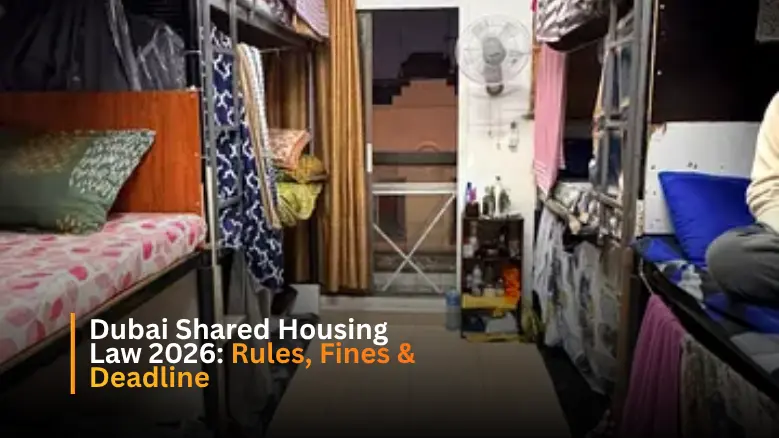
Dubai has introduced a comprehensive legal framework regulating the occupancy, leasing and management of shared residential accommodation. Dubai Law No. 4 of 2026 on the Regulation of Occupancy and Management of Shared Housing in the Emirate of Dubai was issued on 27 February 2026. It establishes a permit-based system covering owners, authorised property-management establishments, occupants, lease contracts and management contracts.
The law is not a general prohibition on people sharing accommodation. Rather, it seeks to replace informal and overcrowded housing arrangements with a regulated system based on permits, registered contracts, occupancy limits and health and safety standards.
Quick Answer
Existing owners and authorised establishments operating shared housing before the law takes effect are expected to receive one year to regularise their position. Based on the date publicly confirmed by Dubai Municipality, that compliance period would run until 26 August 2027, subject to the implementing decisions and any permitted extension.
The most important immediate change is that an ordinary tenant or occupant cannot sublet a room, partition, bed space or any other part of a shared housing unit. Only the owner or a properly authorised establishment may lease shared accommodation.
Key Points at a Glance
- Shared housing remains permissible, but the unit must be properly authorised.
- A permit is required before a property can be allocated for shared housing.
- Tenants and occupants are prohibited from subletting their allocated space.
- Lease and management contracts must be recorded in the Shared Housing Register.
- Occupancy limits and minimum space requirements will be fixed through permits and implementing rules.
- Fines range from AED 500 to AED 500,000, with repeat violations reaching AED 1 million.
- Dubai's Rental Disputes Centre will have exclusive jurisdiction over disputes arising under the law.
Does the Law Make Flat Sharing or Bed-Space Accommodation Illegal?
The law creates a regulated route through which shared housing may lawfully operate. A shared housing arrangement becomes legally vulnerable where, for example:
- The unit has no required permit;
- The property is overcrowded;
- Unauthorised partitions or structural alterations have been constructed;
- The tenant is subletting rooms or bed spaces;
- Safety, sanitation or fire requirements are not met;
- The property is being used contrary to its approved land or building use; or
- Contracts and occupant information are not properly registered.
Accordingly, the correct legal question is not merely whether several people live in the same apartment. The important questions are who is leasing the spaces, whether the unit is permitted, and whether the occupancy and safety conditions are satisfied.
Who Is Covered by the Dubai Shared Housing Law?
Dubai Law No. 4 of 2026 applies throughout the Emirate of Dubai, including special development zones and free zones. It applies to:
- Real estate units allocated for shared housing;
- Owners authorised to use their units for shared housing;
- Individuals occupying spaces in those units;
- Licensed establishments managing or leasing shared housing;
- Shared-housing lease contracts; and
- Management contracts between owners and authorised establishments.
Units formally designated as collective labour accommodation are excluded because they remain subject to a separate regulatory framework. The Government of Dubai Media Office has likewise confirmed that the framework extends to private development zones and free zones while excluding designated collective labour accommodation.
When Does Dubai Law No. 4 of 2026 Take Effect?
Article 40 states that the law comes into force 180 days after publication in the Official Gazette. Dubai Municipality subsequently informed Gulf News that the operative date is:
Owners, operators, management companies and persons currently subletting residential spaces should therefore treat 26 August 2026 as the practical commencement date publicly announced by the competent municipal authority.
Important Legal Note Concerning the Publication Date
The English legal text supplied for this article records that the law appeared in Official Gazette Issue No. 764, dated 12 March 2026. By contrast, Dubai Municipality was reported as stating that the Official Gazette publication date was 27 February 2026.
That is an apparent documentary inconsistency. It would be unsafe for a landlord, tenant or operator to rely upon that inconsistency as a reason to postpone compliance. From a prudent legal-risk perspective, 26 August 2026 should be treated as the operational date unless an official clarification or implementing decision states otherwise.
Can a Tenant Continue Subletting Rooms or Bed Spaces?
The right to lease shared accommodation is restricted to:
- The registered owner of the property; or
- An establishment properly authorised to carry out the shared-housing activity.
A lawful shared-housing structure may therefore involve:
- The owner leasing spaces directly to occupants;
- An authorised establishment managing and leasing the property on behalf of the owner; or
- An authorised establishment leasing the entire property from the owner and then subleasing approved spaces to occupants.
An ordinary tenant is excluded from this chain. The law expressly states that neither an occupant nor a third party may sublease the unit or any allocated space.
What Does This Mean for a "Master Tenant"?
A master tenant who rents an apartment and collects money from roommates, bed-space occupants or room tenants may no longer be able to continue that activity merely on the strength of the original tenancy contract or the landlord's informal consent.
The arrangement may need to be restructured so that:
- The owner contracts directly with each occupant; or
- A duly licensed and authorised establishment manages the shared accommodation.
A general no-objection letter from the owner should not be assumed to replace the statutory permit and licensing requirements.
Is There a One-Year Grace Period?
Article 37 gives owners who had already allocated units for shared housing, and establishments already conducting the activity, one year from the law's entry into force to adjust their position. The Director-General of Dubai Municipality may extend that period once where necessary.
Dubai Municipality has reportedly described this period as a regulatory and warning period before penalties are applied under the new framework. Based on the announced commencement date, the expected regularisation deadline is 26 August 2027.
However, the wording of Article 37 specifically refers to owners and establishments. It does not expressly give occupants or master tenants a separate one-year entitlement to continue unauthorised subletting. Tenants currently collecting rent from other occupants should therefore seek to restructure their arrangements promptly rather than assume that every existing practice is automatically protected until August 2027.
What Permit Is Required for Shared Housing in Dubai?
No individual or company may allocate a real estate unit for shared housing without first obtaining a permit from the competent authority. Before issuing or renewing a permit, the authority must verify compliance with requirements relating to:
- Construction and planning;
- Maximum permitted occupancy;
- Minimum space for each occupant;
- Shared facilities and services;
- Public health;
- Fire safety;
- Sanitation;
- Environmental standards;
- Security; and
- Electrical safety.
A permit will normally be valid for one year and may be renewed for further one-year periods. At the owner's request, the competent authority may issue a two-year permit. Renewal applications must be made at least 30 days before expiry.
The detailed application procedures, occupancy ratios, fees and supporting documents are expected to be addressed in implementing decisions and through Dubai Municipality's approved digital systems. Dubai Municipality told Gulf News that the permit processes would be announced once the relevant procedures are finalised.
Which Properties May Be Approved for Shared Housing?
The law identifies several types of real estate units that may potentially be approved, including:
- Residential apartments;
- Standalone houses;
- Residential complexes;
- Mixed-use buildings;
- Adjoining houses; and
- Multi-storey buildings.
Inclusion in this list does not mean that every apartment or villa automatically qualifies. The location, planning classification, infrastructure, population density, building specifications and social character of the neighbourhood may all be considered when deciding whether shared housing is permitted. Dubai Municipality will also determine maximum occupant numbers, minimum space per resident and required shared facilities.
What Categories of Residents May Use Shared Housing?
The law currently recognises shared accommodation for:
- Families;
- Individual women;
- Individual men;
- Female students;
- Male students; and
- Government employees and workers employed by companies and private institutions.
The applicable criteria may differ depending on the type of property. Dubai Municipality may amend the categories or add further categories through subsequent decisions.
Will Shared Housing Contracts Have to Be Registered?
Yes. The Dubai Land Department must establish and manage an electronic Shared Housing Register linked to Dubai Municipality's digital platform. The register will contain:
- Lease contracts and amendments;
- Management contracts and amendments;
- Occupant information; and
- Other information required by the authorities.
A lease contract must be recorded in the register to become effective. An unregistered contract will generally not be recognised for the purpose of allowing an owner or establishment to enforce its contractual rights.
The law nevertheless protects a bona fide occupant by allowing that occupant to enforce the lease against the owner or establishment even where the lessor failed to register it. This provision makes registration particularly important for owners and operators. Failure to register may substantially weaken their contractual enforcement position.
What Are the Landlord's Principal Obligations?
A lessor operating shared housing must do considerably more than simply collect rent. Among other things, the lessor must:
- Comply with the maximum occupancy stated in the permit;
- Display the permit holder's details in Arabic and English;
- Execute and register a contract with each occupant;
- Provide the occupant with a copy of the contract;
- Keep the unit suitable for residential occupation;
- Avoid unlicensed partitions, additions or modifications;
- Carry out periodic maintenance and emergency repairs;
- Maintain the necessary technical and safety certificates;
- Provide house rules and instructions;
- Give occupants a multilingual rights-and-obligations guide;
- Include emergency contact information; and
- Report observed violations to the competent authority.
Failure to report violations may itself result in liability.
Advertising Requirements
Printed and digital advertisements for shared accommodation must include the authorised establishment's registered trade name and permit number. Misleading descriptions, unauthorised advertisements and promotions inconsistent with the approved use of the property are prohibited. This requirement is likely to affect advertisements placed through property portals, classified websites, social-media groups and messaging applications.
What Are an Occupant's Obligations?
An occupant must:
- Observe health, environmental and safety requirements;
- Take reasonable care of the property;
- Use the allocated space only for residence;
- Not permit unauthorised persons to occupy the space;
- Not carry out a business from the unit;
- Not alter or repair the property without authority;
- Not sublet the allocated space; and
- Permit the lessor to enter for legitimate compliance inspections.
Any purported sublease entered into by an occupant is treated as null and void under the law.
How Much Are the Fines Under the Dubai Shared Housing Law?
Violations may attract fines ranging from:
| Violation Tier | Fine Amount |
|---|---|
| Minimum fine | AED 500 |
| Maximum fine (first violation) | AED 500,000 |
| Repeat violation within one year (doubled, capped) | AED 1,000,000 |
The specific offences and the fine applicable to each offence must be identified through a decision of the Chairman of the Executive Council. Therefore, it would be inaccurate to suggest that every technical breach automatically attracts an AED 500,000 or AED 1 million fine.
Additional administrative measures may include:
- Suspension of the activity for up to six months;
- Cancellation of the shared-housing permit;
- Revocation of the establishment's commercial licence;
- Suspension of utility services;
- Refusal to process transactions concerning the unit;
- Refusal to issue building permits until the breach is corrected;
- Seizure of equipment used in committing the violation;
- Refusal to register contracts; and
- Evacuation of a unit that breaches permit conditions.
Administrative penalties do not prevent separate civil or criminal liability where the circumstances justify it.
Will Dubai Municipality Conduct Inspections?
Yes. The competent authorities are empowered to conduct periodic inspections and field visits to verify compliance by owners, lessors, establishments and occupants. Authorised officers may enter places they are legally permitted to inspect, review contracts and registers, prepare violation reports and seek police assistance where necessary.
The law also provides for periodic and unannounced campaigns where there is reasonable evidence or a documented complaint. At the same time, inspection activity must respect the legal inviolability of private residences. Dubai Municipality has indicated that formal enforcement will follow the official implementation timeline after the necessary procedures are finalised.
Who Decides Shared-Housing Disputes?
The Dubai Rental Disputes Centre has exclusive jurisdiction to hear disputes concerning the rights and obligations established by the law and its implementing decisions.
A person affected by an administrative decision or measure may generally submit a written grievance within 30 days of notification. A separate and much shorter deadline applies to an evacuation decision issued by the Execution Judge: an interested party has seven days from notification to submit a grievance, and execution is stayed while that grievance is considered.
Compliance Checklist for Owners and Shared-Housing Operators
Owners and operators should begin with the following practical steps:
- Audit every property: Identify all units presently occupied by unrelated individuals, families, staff or students.
- Review the legal structure: Determine whether spaces are being leased by the owner, an authorised establishment or an ordinary tenant.
- Stop informal subletting: Do not permit a tenant or unofficial master tenant to collect rent from room or bed-space occupants.
- Check planning and building compliance: Review partitions, room sizes, fire exits, sanitation, ventilation, electrical systems and the approved use of the property.
- Prepare occupant records: Collect accurate identification, contact and occupancy details for registration.
- Review contracts and advertisements: Ensure contracts, online listings and promotional materials can be updated to satisfy the new requirements.
- Monitor implementing decisions: Permit procedures, exact occupancy standards, fees and violation schedules will require further regulatory detail.
- Preserve evidence of compliance: Keep inspection reports, safety certificates, maintenance records, contracts and communications demonstrating genuine regularisation efforts.
Frequently Asked Questions
When does the Dubai shared housing law take effect?
Dubai Municipality has publicly confirmed 26 August 2026 as the effective date. The law itself states that it becomes effective 180 days after publication in the Official Gazette.
Is sharing an apartment illegal in Dubai?
No. Apartment sharing is not prohibited in every case. It must take place in an approved unit under the new permit, occupancy, contractual and safety framework.
Can a Dubai tenant rent a room to another person?
No. Under Dubai Law No. 4 of 2026, an occupant cannot sublet the unit or any space allocated to that occupant. Only the owner or an authorised establishment may lease shared-housing spaces.
Does the landlord's permission make tenant subletting legal?
Not necessarily. The landlord's informal consent does not replace the statutory permit, registration and licensing requirements.
What is the maximum fine?
A first violation may attract a fine of up to AED 500,000. A repeat of the same violation within one year may result in a doubled fine capped at AED 1 million.
Do existing shared-housing businesses have time to comply?
Owners and establishments operating before commencement have one year to regularise their position, with a possible one-time extension by the Director-General of Dubai Municipality.
Where will shared-housing disputes be filed?
The Dubai Rental Disputes Centre has exclusive jurisdiction over disputes relating to rights and obligations arising under the law.
Conclusion
Dubai Law No. 4 of 2026 represents a significant shift from informal flat-sharing arrangements towards professionally managed, documented and safety-compliant shared accommodation.
The legislation does not eliminate shared housing. It determines who may provide it, where it may operate, how many people may occupy a unit, what safety conditions must be met and how occupants' rights are to be documented.
Owners, property managers, companies and tenants should not wait for the end of the adjustment period before reviewing their arrangements. In particular, tenant-led room and bed-space subletting presents an immediate structural concern because the law reserves the right to lease shared accommodation to owners and authorised establishments.
This article provides general information based on Dubai Law No. 4 of 2026, the supplied English legal text and publicly reported statements concerning implementation. It does not constitute legal advice. Application of the law will depend on the facts of each arrangement and on implementing decisions, technical standards and administrative procedures issued by the competent Dubai authorities.